
Enterprise AI adoption has reached 42% among organizations with 1,000 or more employees¹. At the same time, the AI software market is projected to grow from $122 billion in 2024 to $467 billion by 2030². For Saudi tech executives, it's an imperative that demands careful infrastructure planning.
Understanding the Three Deployment Models
Your deployment decision directly impacts long-term ROI, with breakeven points typically occurring after 2-3 years for on-premise solutions³. The question isn't whether to deploy AI, but where to deploy it for maximum competitive advantage. Modern enterprises are discovering that the answer lies not in choosing a single approach, but in embracing hybrid deployment strategies that combine the best of multiple models.
| Characteristics | On-Premise | Cloud | Hybrid |
| Data control | Data control | Data control | Data control |
| Cost | Cost | Cost | Cost |
On-premise infrastructure provides maximum control and data sovereignty, making it ideal for regulated industries and organizations with predictable, high-volume AI workloads. These deployments offer complete control over your AI infrastructure, but they require a high upfront capital investment. However, they provide predictable long-term costs that become increasingly attractive for sustained, high-utilization workloads.
Financial services managers who oversee SAMA regulatory compliance find on-premise solutions essential, as Saudi banks process sensitive customer data that requires absolute control and compliance with local banking regulations. Government and defense applications processing classified information represent another clear use case.
For organizations with sustained, high-volume workloads and strict data sovereignty requirements, on-premise deployments can deliver cost advantages of 30-50% compared to cloud solutions once capital expenditures are amortized. However, this economic model depends on predictable utilization patterns and the ability to maintain local infrastructure expertise.
Cloud infrastructure excels in scenarios requiring rapid scaling and experimentation. Cloud platforms enable rapid deployment through pay-as-you-go pricing models and shared responsibility for infrastructure management. Saudi companies experiencing seasonal demand fluctuations, such as e-commerce platforms during Ramadan, benefit from the cloud's pay-as-you-go pricing and faster deployment times compared to on-premise solutions.
Startups and SMEs with variable AI workloads benefit most from cloud flexibility, while organizations prioritizing experimentation and proof-of-concept development can deploy models 90% faster using cloud platforms. The shared responsibility model enables organizations with limited AI expertise to leverage managed services, allowing them to focus on their core business objectives.
Hybrid deployment represents the most strategic approach to AI infrastructure, offering the flexibility to process sensitive data on-premise while leveraging cloud scalability for variable workloads and edge computing for real-time applications. This integrated approach addresses the complex reality of enterprise operations, where various AI applications have distinct requirements for security, latency, and computational resources.
Consider a major Saudi financial institution that processes millions of transactions daily. Their fraud detection system requires real-time analysis of transaction patterns⁴, making hybrid deployment essential. Sensitive customer data remains securely processed on-premise to meet SAMA regulatory requirements, while machine learning models scale dynamically in the cloud during peak transaction periods. Meanwhile, edge nodes at ATM locations provide instant fraud alerts without transmitting sensitive data across networks.
This hybrid approach delivers measurable results. Organizations implementing integrated deployment strategies report 31.2% better resource utilization compared to single-model approaches⁵. They achieve the cost predictability of on-premise infrastructure for baseline workloads, the elasticity of cloud computing for variable demands, and the ultra-low latency of edge computing for time-critical applications.
While hybrid deployment offers the most strategic advantages, understanding the core deployment models remains essential for making informed architectural decisions.
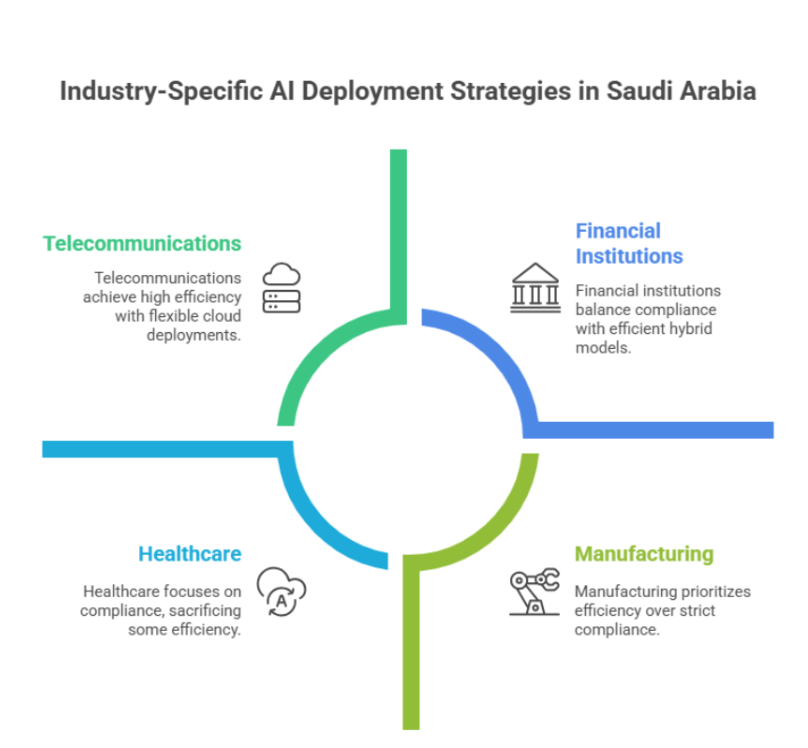
Industry-Specific Deployment Patterns
On-premise infrastructure provides maximum control and data sovereignty, making it ideal for regulated industries and organizations with predictable, high-volume AI workloads. These deployments offer complete control over your AI infrastructure, but they require a high upfront capital investment. However, they provide predictable long-term costs that become increasingly attractive for sustained, high-utilization workloads.
Financial services managers who oversee SAMA regulatory compliance find on-premise solutions essential, as Saudi banks process sensitive customer data that requires absolute control and compliance with local banking regulations. Government and defense applications processing classified information represent another clear use case.
For organizations with sustained, high-volume workloads and strict data sovereignty requirements, on-premise deployments can deliver cost advantages of 30-50% compared to cloud solutions once capital expenditures are amortized. However, this economic model depends on predictable utilization patterns and the ability to maintain local infrastructure expertise.
Cloud infrastructure excels in scenarios requiring rapid scaling and experimentation. Cloud platforms enable rapid deployment through pay-as-you-go pricing models and shared responsibility for infrastructure management. Saudi companies experiencing seasonal demand fluctuations, such as e-commerce platforms during Ramadan, benefit from the cloud's pay-as-you-go pricing and faster deployment times compared to on-premise solutions.

On-premise infrastructure provides maximum control and data sovereignty, making it ideal for regulated industries and organizations with predictable, high-volume AI workloads.
ssssda